Tag: Computing
-
You Can Just Program Biology
The Information Age was a consequence of two developments: the ability to work with information programmatically and the democratization of that capability. We are now entering a similar period in biology. We can now program life itself with the ever cheaper tools of synthetic biology. We believe this era of…
-
Bell’s Inequality
I recently finished Quantum Computing for Everyone, which is a great intro to the basic ideas and math behind quantum computing. I particularly enjoyed its account of Bell’s inequality, which offers a great lesson in the history of science. In the early 20th century, physicists worked out the core of…
-
Blixt
(Crossposted to the USV blog) Existing electrical infrastructure is ill-suited to our current needs. It was developed for a world where we simply sent firm AC power from centralized power plants to end-customers. Today, however, electricity flows multi-directionally, as both AC and DC, and more intermittently. As we continue to…
-
USV AI Roundtable #1: AI and Search
We’re kicking off a new lunch series at USV. We’re going to host monthly roundtables on topics in AI with investors, operators, and researchers in the NYC community. Our first roundtable will be on January 31st on AI and Search. Search engines have been the portal to the internet for…
-
Making Energy Programmable
(crossposted from the USV blog) We’ve previously written about the storage gap. The proliferation of solar has led to an abundance of energy when the sun is out and a dearth of energy when it’s not. Batteries help address this gap by storing excess energy in times of plenty and…
-
Decoding the AI Debate: A Philosophical Perspective
I had a great time speaking last night on a panel with Brendan McCord of the Cosmos Institute and Zoe Weinberg of ex/ante about venture capital, AI, and philosophy. I was really impressed with the group that convened. People were urgently excited to discuss philosophy of mind and language, technical…
-
Towards a Theory of Decentralization
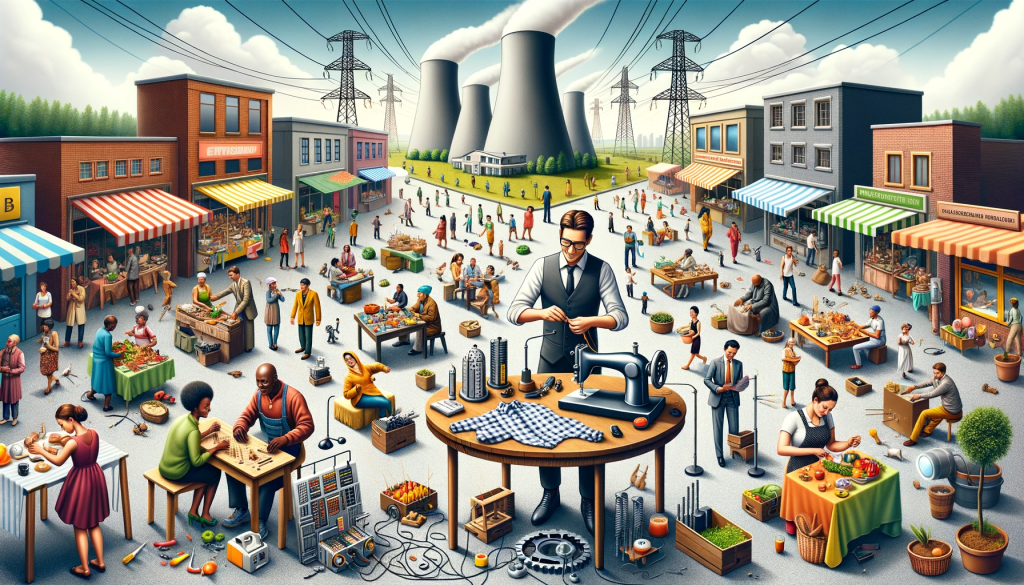
One force that drives centralization is comparative advantage. If I’m sufficiently good at making clothes, it might be mutually advantageous for me to focus on making clothes all day and to free up the person who’s good at making food to do that and the person who’s good at building…
-
Will natural language be the universal interface?

Today, an app’s functionality is usually exposed for manipulation via an application-specific programming interface. Such interfaces conveniently abstract underlying functionality for easy usage but (1) are accessed via code and (2) are different for different applications. Since LLMs solved NLP, it’s now possible for natural language to be a simple,…
-
Decomposing Language Models With Dictionary Learning
This is a cool paper from Anthropic. They trained a model to take the (hard-to-interpret) activations of a neural net and decompose them into distinct features. The goal of this approach is to build a set of features that are causally related to the original model and each uniquely correlate…
-
New Gadgets
Growing up, the tech hardware landscape was highly polytheistic. I had a Gameboy for games, an iPod for music, a camera for pictures, and a phone for communication. Then the smart phone collapsed all of that into a single device, and so for most of my adult life, the only…
 Matthew Mandel