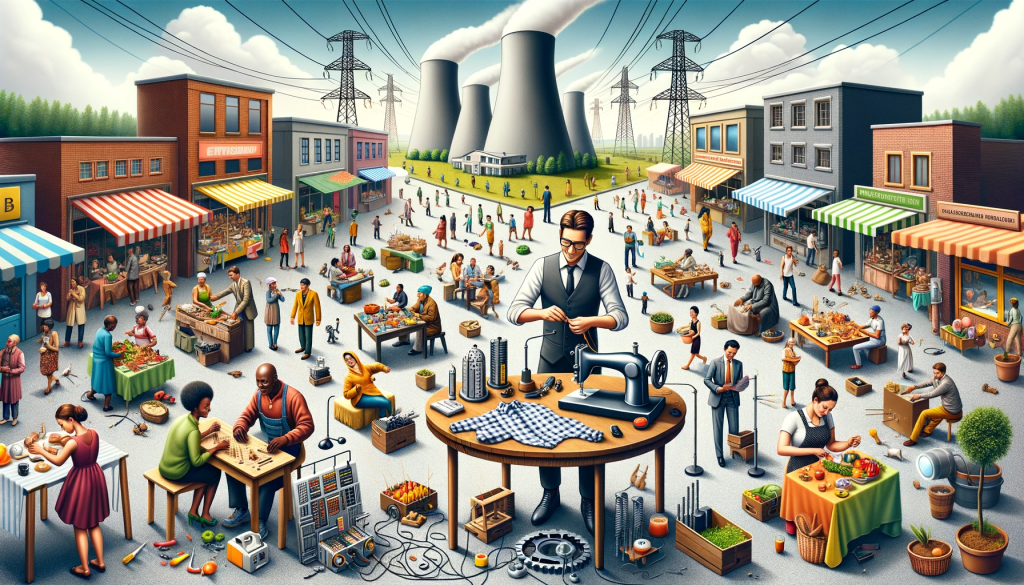
One force that drives centralization is comparative advantage. If I’m sufficiently good at making clothes, it might be mutually advantageous for me to focus on making clothes all day and to free up the person who’s good at making food to do that and the person who’s good at building homes to do that. And as one exercises their comparative advantage, the advantage will compound. If I spend all day making clothes, I’ll get more practice and become better at it. Once I’m spending enough time making clothes, it might pay for me to invest in tools with a large upfront cost that will make me more efficient. In this way, it’s natural for clothing production to centralize under me as food production might under my neighbor.
This dynamic has played out time and again. Managing power plants was complicated and there were economies of scale, which meant that it made sense for certain firms to specialize in power production. That centralized production in a few places and led to the development of the grid to transmit the fruits of their comparative advantage to others.
This centralization comes at a cost though. It creates a single point of failure. If only one person makes food, and they move away from town, then the town might be left hungry.
There’s a more epistemic version of the single point of failure. If there’s only one food producer, they have to guess what kind of food everyone will want. They might make a bad gamble on producing lots of peanut butter, unaware that many in the community are allergic. We all as individuals carry around valuable information for the market in the form of our preferences. If someone knew that I would pay anything for a blue banana, they might invest the effort to procure one. But the more centralized business processes become, the less surface area they probably have with each individual’s preferences.
So why not decentralize everything and avoid those risks?
Decentralization is often easier said than done. The default path looks more like smashing the system than improving upon it. It’s power outages and food shortages. Mass production of goods is hard and not trivially turned over to unspecialized people over night. But, when someone unlocks a way to propagate the knowledge and technology of a centralized actor to diffuse groups with localized understanding – when they figure out how to truly empower the edge – the outcome can be magic.
 Matthew Mandel
Leave a comment