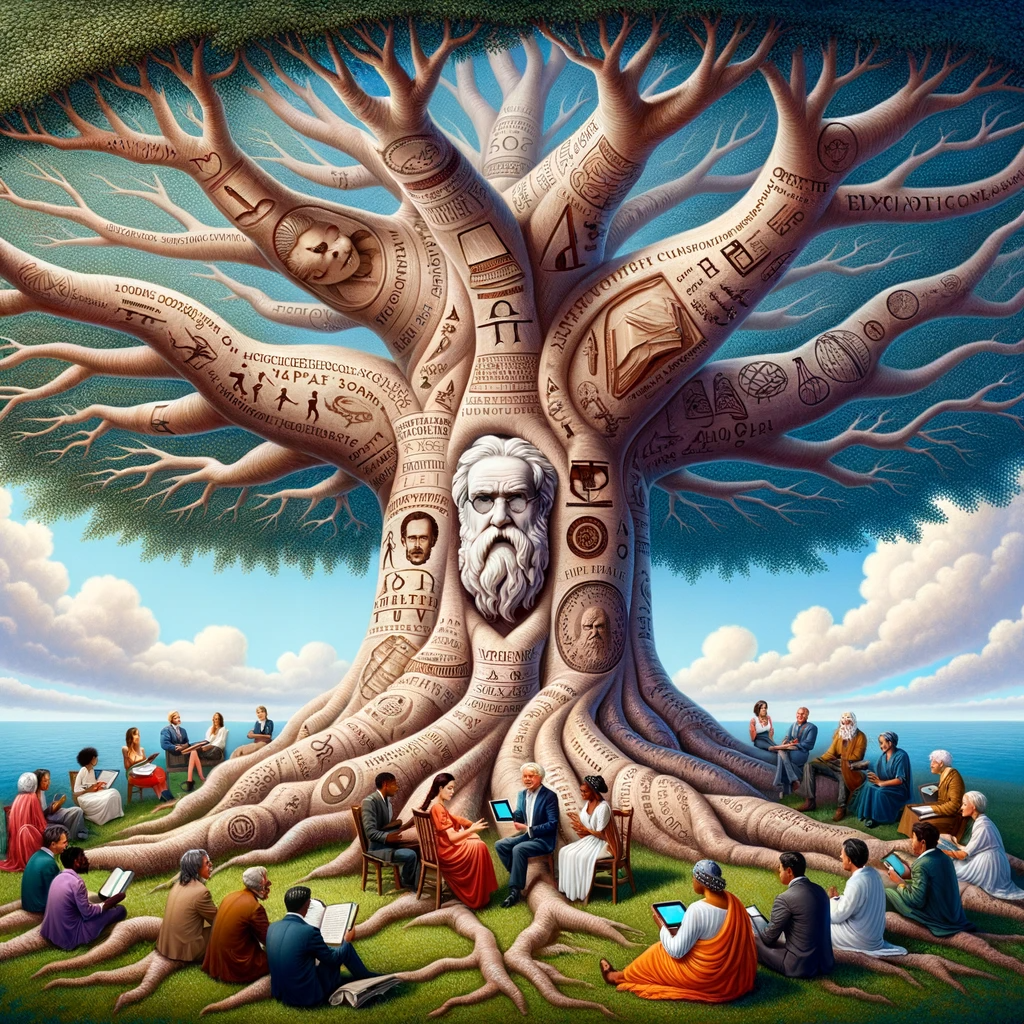
I liked this tweet from Zohar Atkins the other day. What Anne Hathaway’s character missed is how her world, the water she swims in, is downstream of the deliberate creations of artists, which are in turn the result of ideas from others that influenced those artists and so on.
I used to be pretty suspicious of intellectual history as a project. I was far less interested in where ideas come from than which ideas are true, and intellectual history, as I saw it, at its best simply ignored whether ideas were true and at its worst tried to refute ideas by tracing the history of their influences.
I now think that take was a bit reductive. Intellectual history can be instrumentally valuable in helping us uncover and therefore contest our least challenged assumptions about the world by relating familiar concepts to unfamiliar settings and leaving our frame of reference a bit askew. Tom Holland’s Dominion does this pretty effectively by tracing the history of Christian thought back to pre-Christian societies and forward to our ostensibly secular time.
Another way to maybe put it is that intellectual history helps transform questions into more tractable forms by reasoning from historical analogy. In physics, you try to make whatever you’re dealing with into a harmonic oscillator and then you have better tools for getting where you’re going. A young John Rawls wrestled with the history of Christian thought around the Pelagian heresy (which holds that humans are each responsible for their own salvation or damnation) – and later found himself uniquely equipped to restart the field of political philosophy, especially as it concerned questions of merit and the distribution of goods. It would be an uninteresting mistake to try to debunk Rawls’ liberalism as “just secularized anti-Pelagianism”, but it also seems weird to not be interested in the connections between Rawls’ senior thesis on desert and his magnum opus on desert…
 Matthew Mandel
Leave a comment